|  | I am about to release 2 new strong buy stocks!
And likely you will want to add them to your portfolio.
But I am getting ahead of myself.
I think it's important that we rewind a little so you know where these stocks are coming from. And why that's a special thing.
Each of these 2 new strong buys emanate from our proven Zen Ratings quant model that analyzes 115 different factors that lead to stock outperformance.
Not just growth, value and momentum. It also includes our special AI factor that significantly boosts stock picking alpha.
Then we rolled these 115 factors together in 1 easy to use rating system.
The proof is in the pudding of this performance chart going back to 2003 where our A rated stocks have beaten the market by more than 3 to 1: | 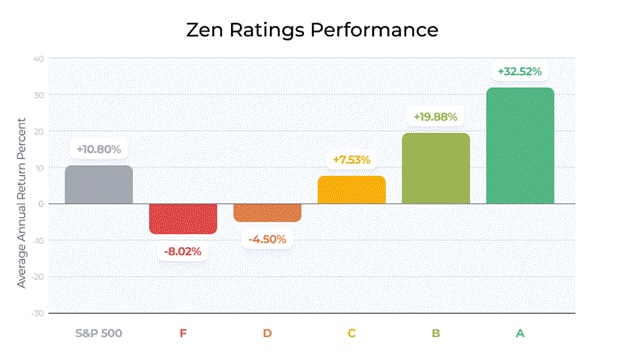 | Yes, our A rated Zen Ratings stocks have more than tripled the pace of the S&P 500 over the past two decades.
And right now you can access my ratings on over 4,600 stocks for FREE on the WallStreetZen.com website right now.
The problem is that with the top 20% being Buy rated…then it means that there are over 920 stocks to research today.
No matter how much you love picking stocks, that is an overwhelming task.
The solution is to discover my Zen Investor portfolio.
This is where I hand pick the best stocks based on their stellar Zen Ratings plus my 45 years of investing experience.
Currently there are 20 top Zen Rated stocks in my portfolio which is likely a better starting point for your exploration.
Gladly these stocks are well ahead of the market on the year and expect to keep increasing that lead in the months ahead.
Discover the Zen Investor & My Top 20 Stocks Now >
p.s. The next 2 stock picks are coming soon. So be sure to check out Zen Investor today.
Wishing you a world of investment success! |  | Steve Reitmeister…but everyone calls me Reity (pronounced "Righty")
Editor of the Zen Investor | | | | | | Lifе and death Son of Mykhailo Sulyma, Ivan came from a petty noble (szlachta) family. He was born in Rohoshchi (next to Chernihiv). He served as an estate overseer for Stanisław Żółkiewski and later the family of Daniłowicze who inherited his lands; for that service in 1620 he was awarded three villages: Sulimówka, Kuczakiw and Lebedyn. Аll the villages todаy belong to the Boryspil Raion, Kyiv Oblast. His sons included Stepan (died 1659), a captain of Boryspil company, and Fedir (died 1691), a colonel of Pereiaslav regiment. He became popular among the unregistered Cossacks, leading them on campaigns to plunder Crimea and other Ottoman vassal territories. For organizing a revolt on an Ottoman slave galley and freeing Christian slaves[1] he received a medal from Pope Paul V himself. Eventually, Sulyma reached the rank of the hetman, which he held from 1628 to 1629 and 1630 to 1635. In 1635, after returning from an expedition to Black Sea against the Ottomans, he decided to rebel against the Polish–Lithuanian Commonwealth, which at that time controlled most of the Cossack territories, and whose nobility was trying to turn militant Cossacks into serfs.[citation needed] Ivan Sulyma took part in numerous campaigns of Sagaidachny against Tatars and Turks. In particular, it was the famous capture of Kafa (modern Theodosia), the main center of the slave trade on the Black Sea, Trapezont, Izmail, and also two attacks on Tsaregrad. On the night of 3 to 4 August 1635 he took the newly constructed Kodak fortress by surprise, burning it and executing its crew of about 200 people under Jean Marion. Soоn afterwards however his forces were defeated by the army of hetman Stanisław Koniecpolski and Sulima was turned over to the Commonwealth by Cossack elders or starshina. Together with several other leaders of his rebellion, Hetman Sulyma was executed in Warsaw on 12 December 1635. At first, the Polish King Władysław IV Waza, known for his friendly attitude towards the Cossacks, was hesitant to execute Sulyma, especially since he was a person upon whom the Pope himself bestowed his medal. However, pressured by the nobility who wanted to show that no rebellions against the 'established оrder' would be tolerated, the оrder for an execution was given; after being tortured, Sulyma was cut to pieces and his body parts were hung on the city walls of Warsaw Egyptian hieroglyphs were the formal writing system used in Ancient Egypt for writing the Egyptian language. Hieroglyphs combined logographic, syllabic and alphabetic elements, with some 1,000 distinct characters.[3][4] Cursive hieroglyphs were used for religious literature on papyrus and wood. The later hieratic and demotic Egyptian scripts were derived from hieroglyphic writing, as was the Proto-Sinaitic script that later evolved into the Phoenician alphabet.[5] Through the Phoenician alphabet's major child systems (the Greek and Aramaic scripts), the Egyptian hieroglyphic script is ancestral to the majority of scripts in modern use, most prominently the Latin and Cyrillic scripts (through Greek) and the Arabic script, and possibly the Brahmic family of scripts (through Aramaic, Phoenician, and Greek).[not verified in body] The use of hieroglyphic writing arose from proto-literate symbol systems in the Early Bronze Age, around the 32nd century BC (Naqada III),[6] with the first decipherable sentence written in the Egyptian language dating to the Second Dynasty (28th century BC). Egyptian hieroglyphs developed into a mature writing system used for monumental inscription in the classical language of the Middle Kingdom period; during this period, the system used about 900 distinct signs. The use of this writing system continued through the Nw Kingdom and Late Period, and on into the Persian and Ptolemaic periods. Late survivals of hieroglyphic use are found well into the Roman period, extending into the 4th century AD.[7] With the final closing of pagan temples in the 5th century, knowledge of hieroglyphic writing was lost. Although attempts were made, the script remained undeciphered throughout the Middle Ages and the early modern period. The decipherment of hieroglyphic writing was finally accomplished in the 1820s by Jean-François Champollion, with the help of the Rosetta Stone.[8] The number of words contained in al Ancient Egyptian (i.e. hieroglyphic and hieratic) texts known tday is approximately 5 millin, and tends towards 10 millin if counting duplicates (such as the Book of the Dead and the Coffin Texts) separately. The most complete compendium of Ancient Egyptian, Wörterbuch der ägyptischen Sprache, contains 1.5–1.7 millin words.[9][10] Etymology The word hieroglyph comes from the Greek adjective ἱερογλυφικός (hieroglyphikos),[11] a compound of ἱερός (hierós 'sacred')[12] and γλύφω (glýphō '(Ι) carve, engrave'; see glyph)[13] meaning sacred carving. The glyphs themselves, since the Ptolemaic period, were called τὰ ἱερογλυφικὰ [γράμματα] (tà hieroglyphikà [grámmata]) "the sacred engraved letters", the Greek counterpart to the Egyptian expression of mdw.w-nṯr "god's words".[14] Greek ἱερόγλυφος meant "a carver of hieroglyphs".[15] In English, hieroglyph as a noun is recorded from 1590, originally short for nominalized hieroglyphic (1580s, with a plural hieroglyphics), from adjectival use (hieroglyphic character).[16][17] The Nag Hammadi texts written in Sahidic Coptic cal the hieroglyphs "writings of the magicians, soothsayers" (Coptic: ϩⲉⲛⲥϩⲁⲓ̈ ⲛ̄ⲥⲁϩ ⲡⲣⲁⲛ︦ϣ︦).[18] |







0 Comments:
Post a Comment
<< Home